
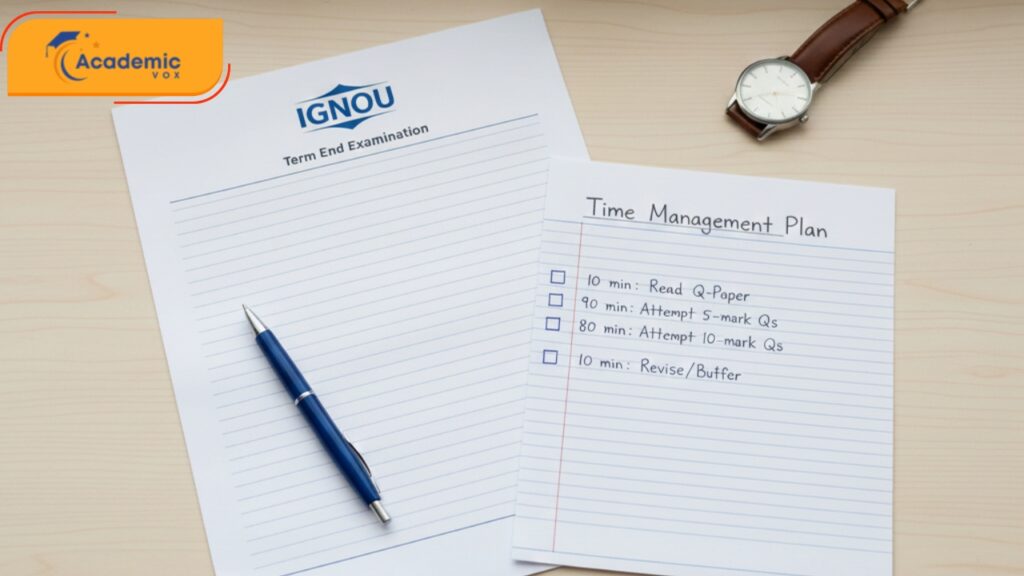
Best Way to Finish Your IGNOU Answer Sheet on Time
Completing your IGNOU answer sheet within the time limit is key to scoring well. Many students lose marks not due to a lack of knowledge, but because they don’t manage their time well. This guide offers step-by-step strategies, practical tips, and exam techniques to help you finish your answer sheet on time and confidently.
Understanding Time Allocation in IGNOU Exams
Know the Exam Duration
Most IGNOU Term-End Exams last 3 hours. Knowing how to split this time among different question types is the first step to managing your time effectively.
Types of Questions
- Long-answer questions (10–12 marks)
- Medium/short-answer questions (4–6 marks)
- Very short notes or 2-mark questions
Dividing time for each type makes sure you can attempt all questions.
Preparation Before Exam Day
Practice Mock Answer Sheets
Before the exam, complete at least 2–3 mock papers under timed conditions. This builds your writing speed and confidence.
Prepare One-Page Notes
Keep summaries, key points, and diagrams handy for quick review during study time. Being familiar with your notes speeds up your writing.
Organize Stationery in Advance
Make sure your pens, pencils, erasers, and hall ticket are ready a day before the exam to avoid delays.
Strategizing Your Answer Sheet Attempt
Read the Entire Paper First
Spend the first 5 minutes scanning all questions. Identify:
- Easy questions
- Questions you understand well
- Questions that need more time
This helps you plan the order in which to tackle questions.
Attempt Easy Questions First
Starting with familiar questions boosts your confidence and saves time for harder ones later.
Allocate Time According to Marks
- 10-mark question → 12–15 minutes
- 6-mark question → 8–10 minutes
- 4-mark question → 5 minutes
- 2-mark question → 2–3 minutes
Following this schedule ensures attention to every question.
Writing Answers Efficiently
Use Structured Answers
Long answers should include:
- Introduction
- Explanation with headings
- Examples
- Conclusion
Structured answers are easier to write and read, saving time.
Use Bullet Points Where Possible
Short and medium answers can be written in bullet points. This increases clarity and reduces writing time.
Avoid Overwriting
Stick to relevant points. Writing unnecessary content wastes time and may confuse the evaluator.
Handling Difficult Questions
Move On If Stuck
Don’t spend too much time on a single question. Attempt what you know first and then return to the difficult ones.
Break the Question Into Parts
Divide a hard question into smaller parts. Writing what you know is better than leaving it blank.
Use Examples
Partial answers with examples can still earn marks. Quick examples enhance your content quality and save time.
Time-Saving Techniques During Exam
Use Abbreviations Where Appropriate
Abbreviating repetitive terms saves writing time, but keep it clear.
Underline Keywords
Highlighting key terms ensures you don’t waste time looking for what to emphasize later.
Keep a Timer
Mentally track time for each section. Stick to your plan to finish the paper.
Managing Last 10–15 Minutes
Quick Revision
Check for:
- Missed questions
- Spelling or numbering errors
- Unlabeled diagrams
Add Extra Points
If time allows, quickly add any remaining points or examples.
Do Not Panic
Even if you’re behind schedule, stay calm. Panicking wastes more time and lowers the quality of your answers.
Maintaining Handwriting and Presentation
Neat and Consistent Writing
Clear handwriting ensures the examiner can read your answers without difficulty.
Leave Spaces Between Answers
Spacing keeps the answer sheet organized and allows for easy additions during the final minutes.
Use Diagrams When Required
Quick labeled diagrams explain concepts faster than lengthy descriptions.
Post-Exam Tips for Time Management Improvement
Analyze Your Performance
After each exam, note which questions took longer. Plan a better approach for future exams.
Practice More Mock Papers
Time-bound mock papers help you improve your writing speed and reduce stress on exam day.
Identify Weak Points
Focus on topics that consistently take longer to answer and revise them effectively.
Conclusion
Finishing your IGNOU answer sheet on time requires planning, practice, and focused writing. By following a solid time allocation strategy, writing structured answers, practicing mock papers, and staying calm during the exam, students can complete every question efficiently and maximize their scores. Remember, managing your time is as important as studying the syllabus itself.